


Early Islamic geometricians treated geometry as a generative language through which space, meaning, and contemplation could be experienced. Visit the SUPPLEMENTS page. It contains essay, paper, and book references about early Islamic architectural design and construction methods.
First review the methods to see how they work. Then duplicate the examples shown, followed by your own developments and applications. Move from strict method to intuitive development. Once engaged in an intuitive/analytic/logical development, see where your mind goes. I am available for workshops, online or live.
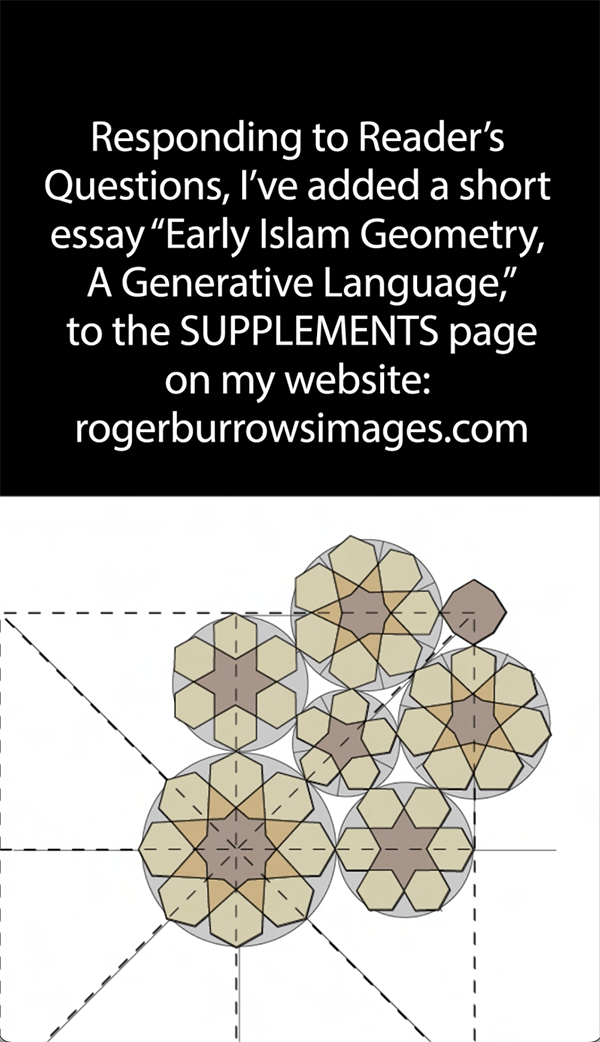
In Response to a Reader’s question regarding the Ray Method.
The method starts with a regular polygon—an octagon for example. Extend the polygon’s lines of symmetry outward from that first polygon. Along one of those extended symmetry lines place the center of a second regular polygon (say, a hexagon) and extend its symmetry lines as well).
Where the symmetry lines of the two polygons intersect, certain angles will either exactly—or very closely—accommodate a third regular polygon. That third polygon brings its own symmetry lines, which create new intersections.
The process can stop once three polygons are established, or it can continue until the construction naturally resolves into an enclosing repeatable tile shape (often a square). That tile then repeats across a surface.
What distinguishes this approach is that the sequence of polygons isn’t arbitrary. It links to the ABJAD number–letter system, where numbers such as 8‑6‑5 correspond to Arabic tri‑literal roots. So as you move from one polygon to the next, you’re not just following geometric rays—you’re also moving through a chain of semantic associations.
The “immersion” happens internally. You visualize the geometric path from the first polygon to the next, and the next, while simultaneously holding the meanings of the corresponding root words (from pre‑consonantal Arabic) in mind. The purpose isn’t the specific geometric route you take, but the fusion of spatial reasoning with emotional and conceptual resonance.
I hope that gives you a clearer sense of what’s happening in the animation and the concept.