Explore Visual Thinking Through Time
Overview
Visual Thinking, Seeing Through Time is a five-book series. It explores the development of visual logic from archaic humans through early civilizations. It continues into the age of artificial intelligence. The series examines how visual‑cognitive structures shape human reasoning across the arts. These structures affect architecture and geometry. This reveals deep connections between perception, culture, and design.
About the Author
Roger Burrows is a teacher of spatial geometries, architecture, robotics, and three‑dimensional software. His work bridges deep‑time anthropology with the technical evolution of design and cognition. It offers readers a framework for understanding how visual thinking has guided human creativity across history.
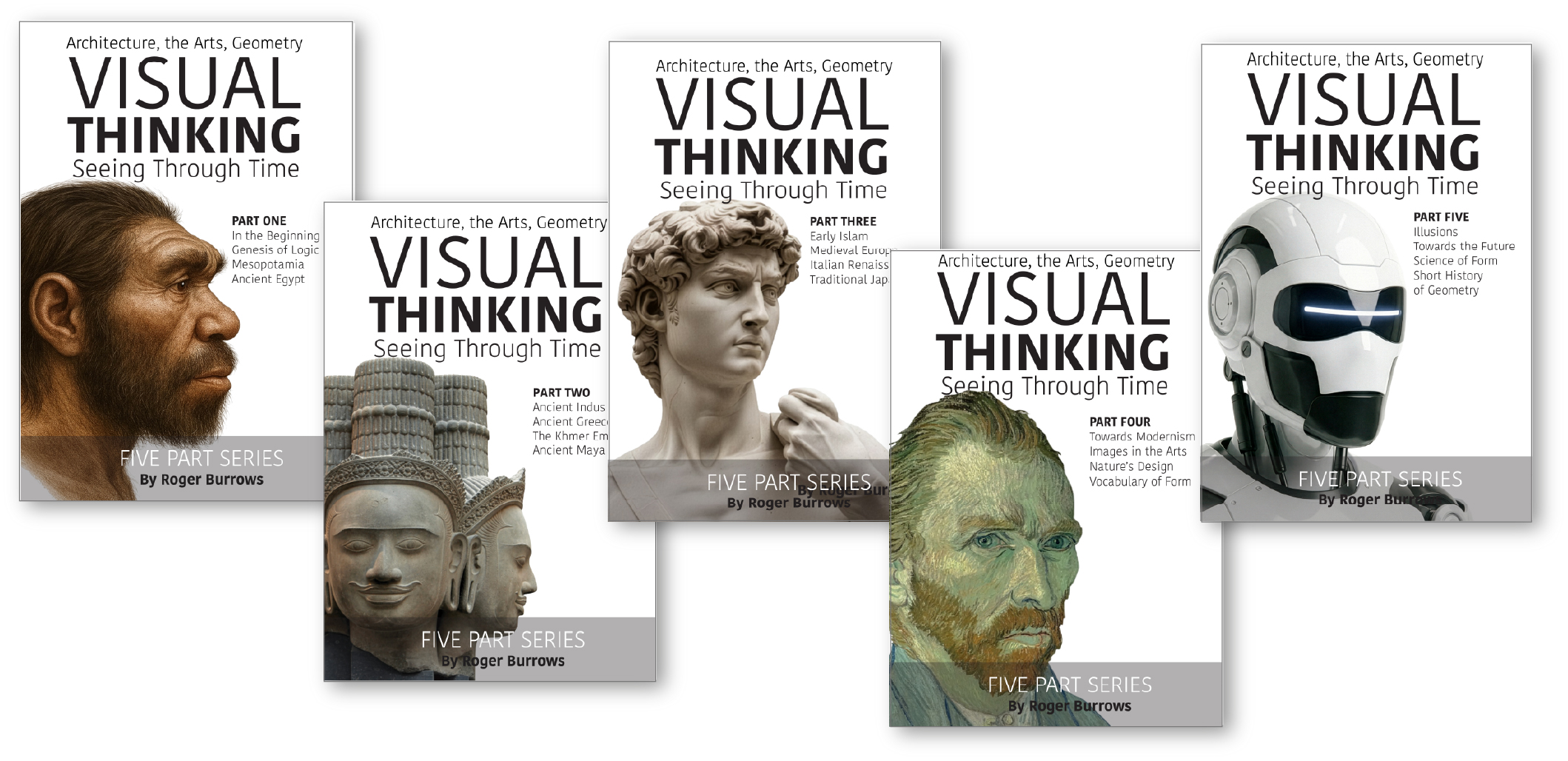
This volume explains the development of visual, verbal, and emotional thinking. The explanation starts from early humans and goes to the first civilizations. It describes the rise of Homo sapiens and the emergence of early architecture and art. The evolution of visual thinking shaped the thinking styles of Mesopotamia and Egypt.
Book 2: Comparative Cultural Thought
This book compares the standardized thinking of Ancient Egypt. It contrasts this with the analytical approaches of the Greeks. It also explores the emotionally rich perspectives of the Harappan, Khmer, and Maya cultures. These perspectives highlight the global diversity of human thought.
Book 3: Cultural Biases in Art and Architecture
This volume examines the impact of cultural biases on creative works. It discusses Islamic geometric art and the traditions of Medieval and Renaissance Europe and Japan. It highlights how different cultures uniquely combine emotional and logical thinking in their architectural and artistic structures.
Book 4: The Shift to Modernism
This book examines the transition to modernism. Design became centered on efficiency, mass production, and straightforward forms. It analyzes the decline of traditional symbolism as artists and architects explored new ways to enhance everyday life.
Book 5: Technology, Perception, and the Future of Geometry
The final volume explores how illusions affect art and architecture. It also examines the role of artificial intelligence in design. It describes new technologies and design methods. It concludes with a brief history of geometry that connects ancient techniques to modern applications.